


Nelson Ishiyama, owner of Henry’s Fork Lodge, has spent over 50 years studying trout, bugs, and water, from the casting ponds of Golden Gate Park to the legendary pools of the Henry’s Fork.
In this episode, Nelson shares how the lodge came to life with the help of a world-class architect and why he believes service and conservation should always be at the heart of a great fly fishing experience.
We also talk about:
- What it takes to build and protect a true fly fishing legacy
- His love for sight fishing on the Fork
- The flies he trusts most


Find the show: Follow the Show | Overcast | Spotify

Show Notes with Nelson Ishiyama on the Henry’s Fork Lodge
The Henry’s Fork Lodge just wrapped up its season, and Nelson’s back home in California after spending five months in Idaho. The lodge runs through early October, right when the colors change and the river slows down.
About Nelson Ishiyama
Nelson’s fly fishing story started way back as a teenager, thanks to a Field & Stream subscription sent by a family friend. Reading writers like Ted Trueblood, who is a Western angler from Idaho, got him hooked on fishing before he ever picked up a rod.
Growing up in the Bay Area, he found his way to the Golden Gate Angling and Casting Club in San Francisco. It was there he learned from some of the best, like Mel Krieger, Andy Puyans, Jim Adams, and Mike Fong.
Those years spent around skilled casters, tiers, and storytellers shaped how he saw the sport and eventually inspired what would become Henry’s Fork Lodge, one of Idaho’s most admired fly fishing destinations.
Want to hear more about the Golden Gate Angling and Casting Club?
Check out episode 598 with Jim Dawson.
The Golden Gate Casting Club Connection
The Golden Gate Casting Club has been a fly fishing hub since the 1930s. Built by the federal government inside Golden Gate Park, the casting ponds quickly became the gathering spot for some of the best casters and fly tiers in the country. Northern California was already a hub for trout, steelhead, and salmon fishing, and the club just brought all that energy together.
Nelson still heads there on most Saturdays. He meets up with friends, casts a few rods, and talks fishing. The group often trades rods to test new gear.
The Henry’s Fork Lodge
The idea for Henry’s Fork Lodge came to life in 1990. Nelson wasn’t looking to build anything at the time, but when a friend showed him a piece of property on the river, he knew right away it was the perfect spot for a lodge.
The Henry’s Fork area was already well-known among serious anglers, but far less crowded than today. Now you’ve got outfitters like Henry’s Fork Anglers, TroutHunter, Big Sky Anglers, and a bunch of South Fork guides nearby. The lodge sits right in the middle of it all, with easy access to great fishing from Yellowstone Park down to the Teton and South Fork.
The lodge itself sits right on the riverbank, about thirty feet above the water. Guests can literally step outside and fish, surrounded by 25 miles of untouched Forest Service land on the opposite side. No buildings, no people, just the Henry’s Fork flowing by.

Henry’s Fork Lodge Season and Best Time to Visit
Henry’s Fork Lodge runs from Memorial Day weekend, which is the official start of trout season in Idaho, until early October. That’s when the weather and the fishing are at their best.
Nelson says Memorial Day marks the kickoff of salmon fly season, which really gets things going. While parts of the river remain open throughout the year, most of the action happens during this stretch.
If you’re planning to book a stay, Nelson recommends locking in dates early, especially for June through mid-July. Although he says many guests rebook before they even check out. Still, there are often some openings as people rotate in and out, so it’s worth checking for a spot.

The Story Behind the Henry’s Fork Lodge Design
When Nelson Ishiyama set out to build Henry’s Fork Lodge, he wanted a place that felt first-class but still fit the Idaho landscape.
The architect behind it, Joseph Esherick, was a member of the Golden Gate Casting Club and one of California’s most respected architects. He served as dean of architecture at UC Berkeley and was known for his love of fly fishing, but had never designed a fishing lodge before.
Esherick visited the site, studied local barns and old buildings, and then came up with a beautiful design that captured the spirit of the Henry’s Fork. The result? A lodge so well-crafted it was featured in architectural magazines.
And it’s not just the design that stands out. With three chefs and a breakfast cook, guests remember the food just as much as the fishing.

Fly Fishing the Henry’s Fork River
The Henry’s Fork River isn’t just a technical spring creek; it’s a mix of everything. It starts in the fast, rough waters of Box Canyon, where anglers drift with nymphs or streamers.
Below that is Harriman State Park, known as the Wimbledon of fly fishing, where big, selective trout test even the best anglers.
Then the river drops into another canyon, which is tough to reach but worth it, before flowing through farmland where you’ll find more easygoing dry fly and streamer water.
That’s what makes the Henry’s Fork special. Whether you’re brand new to fly fishing or have years under your belt, there’s a stretch of water here for you. Even first-timers can have a great day on the river with the right guide and a little help from the crew at Henry’s Fork Lodge.
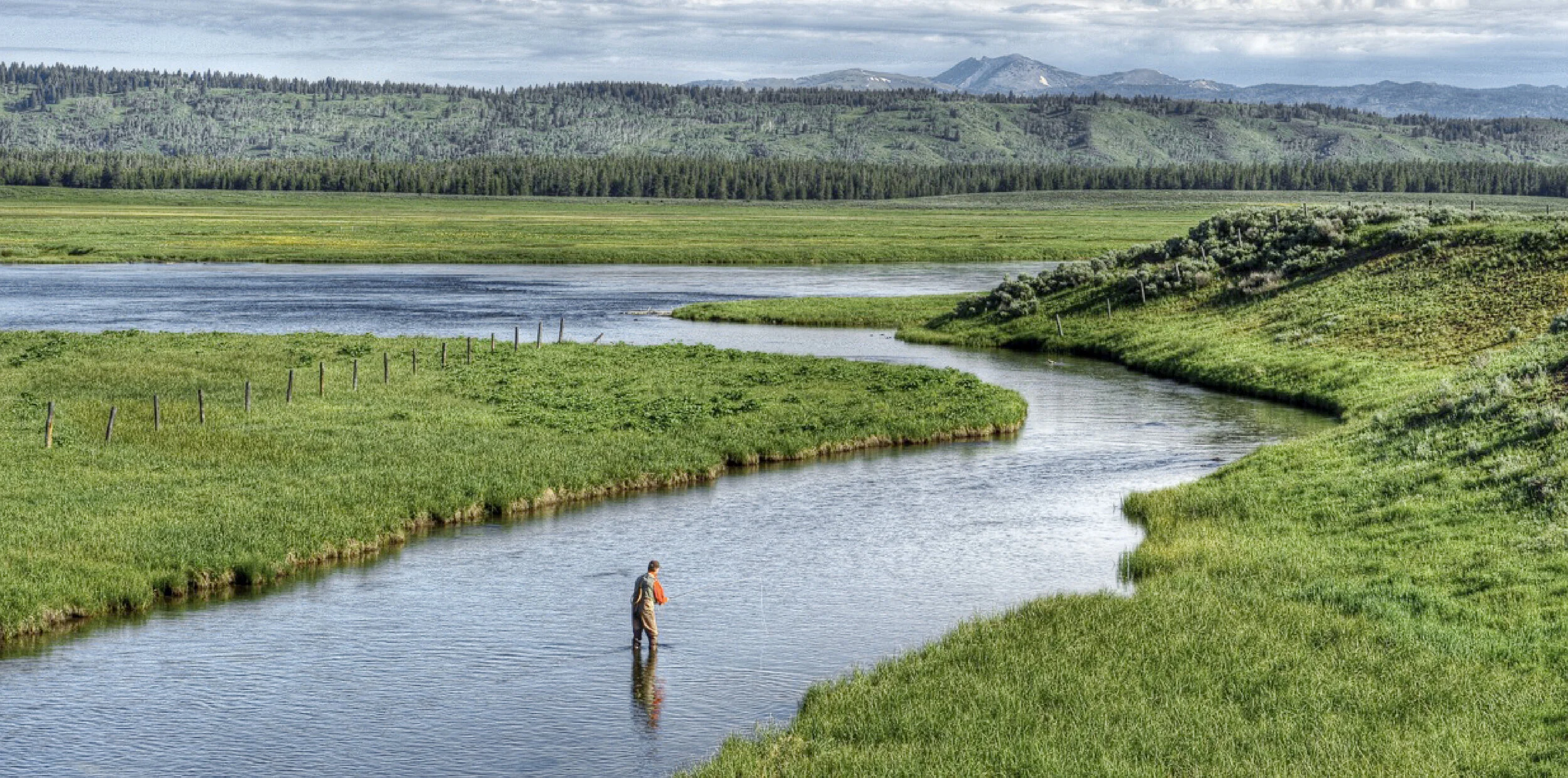
What makes Harriman different is its spring creek character. The water is smooth and slow, the hatches are constant and varied, and the fish are selective.
It’s beautiful but demanding and not everyone’s cup of tea. Even the most experienced anglers get skunked there sometimes.
Hatches on the Henry’s Fork River
Nelson says the hatches change through the season and even from river to river. He first learned about entomology at the Golden Gate Casting Club, where a UC Berkeley professor taught a class full of fly fishers. That’s where he got his start, then he dove into books on fly fishing and fly tying to learn the rest.
Some of the most famous hatches on the Henry’s Fork include:
- Green Drakes (late May)
- Brown Drakes
- Salmon Flies and Golden Stones – found in Box Canyon and the Lower Fork around late May to early June.
- By mid-October, it’s all about the Blue-Winged Olives and Mahogany Duns, with midges hanging around all year.
You can technically fish year-round, but Nelson says once it drops below 40 degrees, it’s mostly just the locals braving the cold.

Fishing Conditions and Conservation Efforts
Nelson still fishes while running Henry’s Fork Lodge. He spends mornings and evenings with guests and heads out to the river a few days a week. He also supports conservation groups like the Henry’s Fork Foundation and The Nature Conservancy.
Nelson says Mayfly numbers have dropped over the years, possibly due to climate change, but main hatches are still strong. Fishing varies by location.
It can be slower at Harriman Ranch, and better in Box Canyon and lower river sections. Trout grow fast, about an inch a month. Most anglers target fish between 16 and 18 inches.
Nelson recommends supporting local organizations to help protect the Henry’s Fork watershed. These groups work to prevent unwise development and preserve wildlife corridors.
- Henry’s Fork Foundation – Focused on river and habitat conservation.
- Nature Conservancy – Protects large tracts of land and migration paths for wildlife like grizzlies, wolverines, and pronghorns.
- Western Rivers Conservancy – Supports sustainable river management and habitat preservation.
Things to Do at Henry’s Fork Lodge Beyond Fishing
Henry’s Fork Lodge isn’t just about fishing. Guests can explore Yellowstone Park, which is just 45 minutes away. The area is full of wildlife, including moose, bear, elk, and deer. Bird watchers will love the bird sanctuary on the Railroad Ranch.
Fishing guides set expectations, so visitors know it’s not guaranteed to catch big fish every day. Sometimes you might not catch any. The combination of the lodge, wildlife, and the river makes for a full experience.

Nelson’s Top Fly Patterns for the Henry’s Fork

Nelson shares his go-to flies for the Henry’s Fork and how he approaches fly tying. He mostly fishes dry flies but also uses nymphs just under the surface to target feeding fish.
- Sparkle Dunn – Most used fly for dun hatches.
- X Caddis – Great for surface action, developed by Craig Matthews and his wife.
- Custom Flies – Nelson ties his own patterns that aren’t found in shops, especially for tricky fish or flat water conditions.
He emphasizes that fly fishing is always evolving. New materials, better hackle, and observing fish behavior keep the challenge fresh. Even after decades, there’s always a new fly to invent or improve.
Planning your Henry’s Fork Adventure?
Check in with Nelson at Henry’s Fork Lodge.
Follow them on Instagram and YouTube.